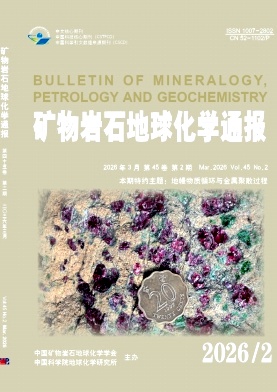
Bulletin of Mineralogy, Petrology, and Geochemistry is a scholarly journal focusing on Earth sciences. It is backed by the China Mineralogical Society and the Institute of Geochemistry at the Chinese Academy of Sciences and is supervised by the China Association for Science and Technology. The journal's main goal is to share research outcomes, thorough evaluations, exchange ideas, and give direction for the society in the domains of mineralogy, petrology, and geochemistry, both nationally and globally. The principal portions of the publication consist of "Research Achievements," "Reviews," "Geoscience Forum," "New Discoveries and Perspectives," "New Technologies and Methods," "Voice of the Society," as well as occasional unique sections. The magazine is released on the 10th of every other odd-numbered month.
Submission requirements and notes:
1. To submit an article, please use the online office platform (www.bmpg.ac.cn). When submitting, authors must state that the manuscript is unique to our magazine and has not been previously published. Additionally, submitted articles cannot have been published elsewhere. This publication does not allow articles that are submitted to multiple publications at the same time. If the author has already submitted the manuscript to another publication, they must first inform this publication and request withdrawal from the other one to avoid the problem of simultaneous submissions. The author is responsible for any economic loss incurred by this publication due to any violation of the regulations mentioned above.
2. This journal welcomes manuscripts written in English and Chinese. English manuscripts must follow the same guidelines as Chinese manuscripts which include a Chinese title, author and affiliation, Chinese summary, and keywords.
3. The author retains the copyright of the manuscript as stated by the Copyright Law. The author is responsible for the content of the manuscript. The corresponding writer must ensure that all authors have read and approved this document before sending. If any changes to authorship occur post-submission, all original authors must provide written consent.
4. Typically, the editorial office responds to submissions within 3 months of receipt. If the writer hasn't received an acceptance notification from this periodical after three months, they can send the content to another periodical. Once the editorial board has approved and scheduled the article for publication, the author is not permitted to retract the manuscript. If they do, the periodical may ask for compensation to cover related financial damages.
5. Moreover, this journal offers an electronic version on its website, in addition to the printed copy. Once a manuscript is accepted, the author transfers the copyright for all versions to this journal.
6. In accordance with the Copyright Law, this journal can modify the submitted text. But, the author's agreement is required for making significant changes to the content.
7. Ensure your writing has clear arguments supported by trustworthy data, rigorous logic, and reasonable reasoning. Your presentation should have a logical and easy-to-follow structure, and it should be written using concise language that is easily understood. Your word count is not limited and should be determined by the author according to the content. However, this journal favors shorter articles, so reports and briefs should be particularly concise. Research achievements and review articles can be longer, but should still be succinct. Research articles and reviews need a Chinese and English abstract, English title, 3-8 Chinese and English keywords, author's name in Pinyin, and Chinese and English affiliations. For research articles, the abstract should state the purpose, methods, results, and conclusions or discussions. For review and other articles, the abstract should summarize the main research, recent advances, existing problems, and future work. The English summary should be brief, with a maximum of 180 words, and the Chinese summary should be around 300 characters. The English summary should be brief, with a maximum of 180 words, and the Chinese summary should be around 300 characters. For keywords, stick with 3-8 terms in both languages.
8. Additionally, limit the authors to the main participants only, with a maximum of four authors from the same establishment and no more than eight authors from multiple establishments. The main and corresponding authors must introduce themselves briefly, including their name, birth year, gender, degree, title, field of study, contact phone number, and email. The acknowledgments section may mention auxiliary researchers. Graduate students must provide the corresponding author’s information, and they should be in charge of the manuscript review and publication process.
9. The written work must utilize standard, simplified characters and follow the national standard GB/Tl5835-1995 for numbering. Additionally, official units of measurement should be utilized. Foreign letters and symbols should indicate capitalization, regular or italic type, and black or white type; letters, numerals, and symbols in superscript or subscript should be clearly distinguished in terms of height. Annotations should be used for any letters, symbols, or numbers that may be easily confused.
10. The document should only contain essential charts and graphs, positioned in the text following the "text first, graph second" principle. The manuscript should be in Word format, and diagrams must be in CorelDraw, EPS format with at least 600 dpi for photographs and mass spectrometry diagrams. The table content needs to be brief, using a three-line structure when possible. The numbers and names of the charts and tables should be labeled in English and Chinese below the frames, and the notes listed beneath them.
11. Please cite other people's information and opinions in your writing by marking them in the text and listing the references at the end in accordance with Copyright Law. Our journal uses the author-year system for references. All authors are listed last name first, separated by a "," if there are multiple authors, and a full first name is used with no abbreviations. According to the author's surname in Latin alphabetical order of the reference list, while retaining all Chinese references as an appendix at the end of the text.
12. Once the manuscript has been edited and typeset, an initial version will be sent to the author as a PDF file to review before printing. The author will not be allowed to make significant alterations to the original manuscript and must submit the proof within a designated time frame for publication.
13. Once the paper is published, all authors must sign the "Copyright Transfer Statement." This statement transfers reproduction, distribution, network transmission, translation, and compilation rights of the paper to the first organizer of the journal worldwide. The journal's editorial office will charge the paper's author a certain publication fee. After publication, the authors will receive a one-time payment for this manuscript version, two copies of the current journal issue, and access to the full electronic version.